How I use AI (Oct 2026)
Wow, things have changed.
Last October, I took stock of how I was using AI — specifically the cool stuff like LLMs that we call 'AI’. I’m so glad I did. Things are very, very different 12 months later.


Background
I still believe I use AI fairly typically, but I’ve had a notable change in background. Last October, I was an engineer on Microsoft’s Windows AI team. I am now a research engineer at Salesforce AI Research. I spend more time supporting scientists & building rapid prototypes, rather than working with a large team of engineers. I spend about ~$3,000/month in tokens.
In any case, I mostly use AI in the same ways as last year:
- Coding
- Research & search
- Summarization & transcription & (new) voice
- Writing
- Art & music & (new) video
Also new this year, I’ve drafted a personal AI policy; we’ll start there.
As before, this remains purely my opinion & speculation. If you use AI differently, let me know!
My AI policy
This year I began drafting a personal AI policy — as in, a document for how I want to use AI in my life. I am very excited about it. I am also working on an explicit AI policy for this site (still thinkin’; probably based on Hank Green’s policy), but a personal policy is to give me a framework for using these tools day-to-day.
AI leaks into life. Teammates ask Claude to write their Slack messages, grandparents generate creepy memes of their grandchildren, and researchers delegate their thinking to machines. I’ve seen all of these things; even strong creators like Hank Green and BrainPOP get lost.
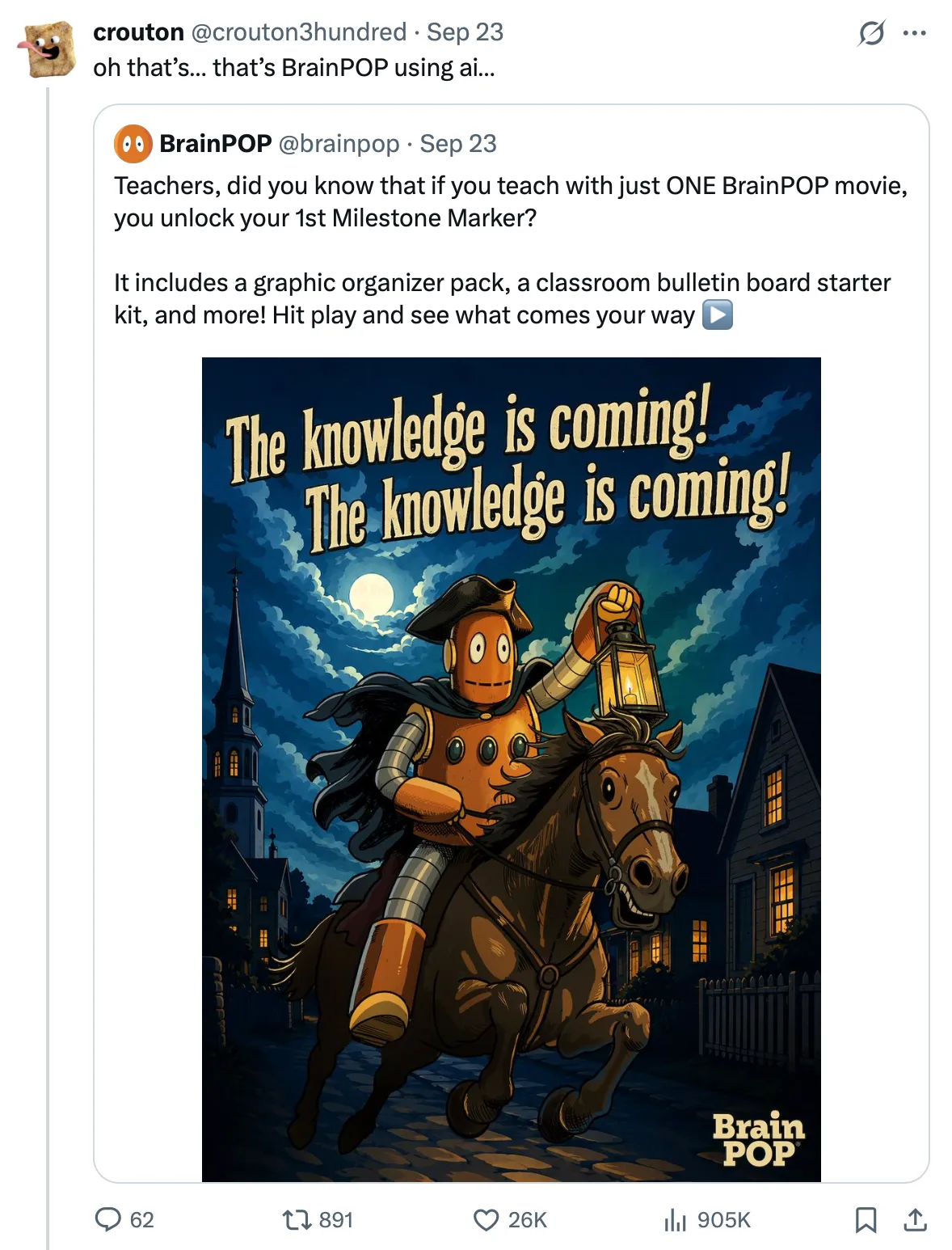
BrainPOP using AI art, perhaps unknowingly
Humans clearly do not have norms for using these tools, and we’re messing up. I hope that a personal policy will ground me as AI becomes smarter. I hope to adapt that policy over time, and I’m eager to see how it evolves. I’m also open to draft 1 being utterly, hopelessly wrong.
Ultimately, I want to spend my life making cool things with other people. AI can help, AI can hurt. A policy helps me find the difference.
Coding
Writing code is solved.
Last year, I waxed poetic about how GitHub Copilot autocomplete transformed how I write code.
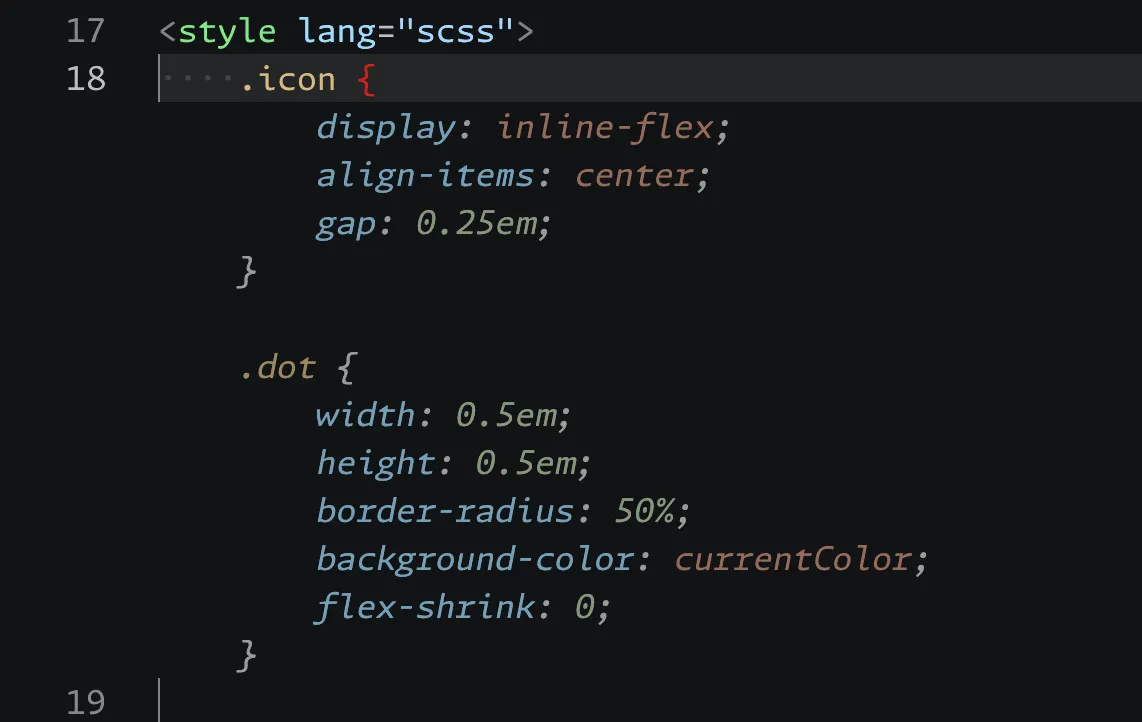
Autocomplete is still good (the dim lines)
Well, uh, I no longer write much code. Agentic coding has made it obsolete.
My workday now means managing ~5–6 Claude Code (or OpenCode or Codex or Pi) agents. I’ll give Claude a feature to implement, or a bug to reproduce, or any other task I used to do by hand; each agent gets its own copy of the code (a Git worktree, if you’re technical), then just… gets to work. The agents write code, run tests, even create & review PRs.
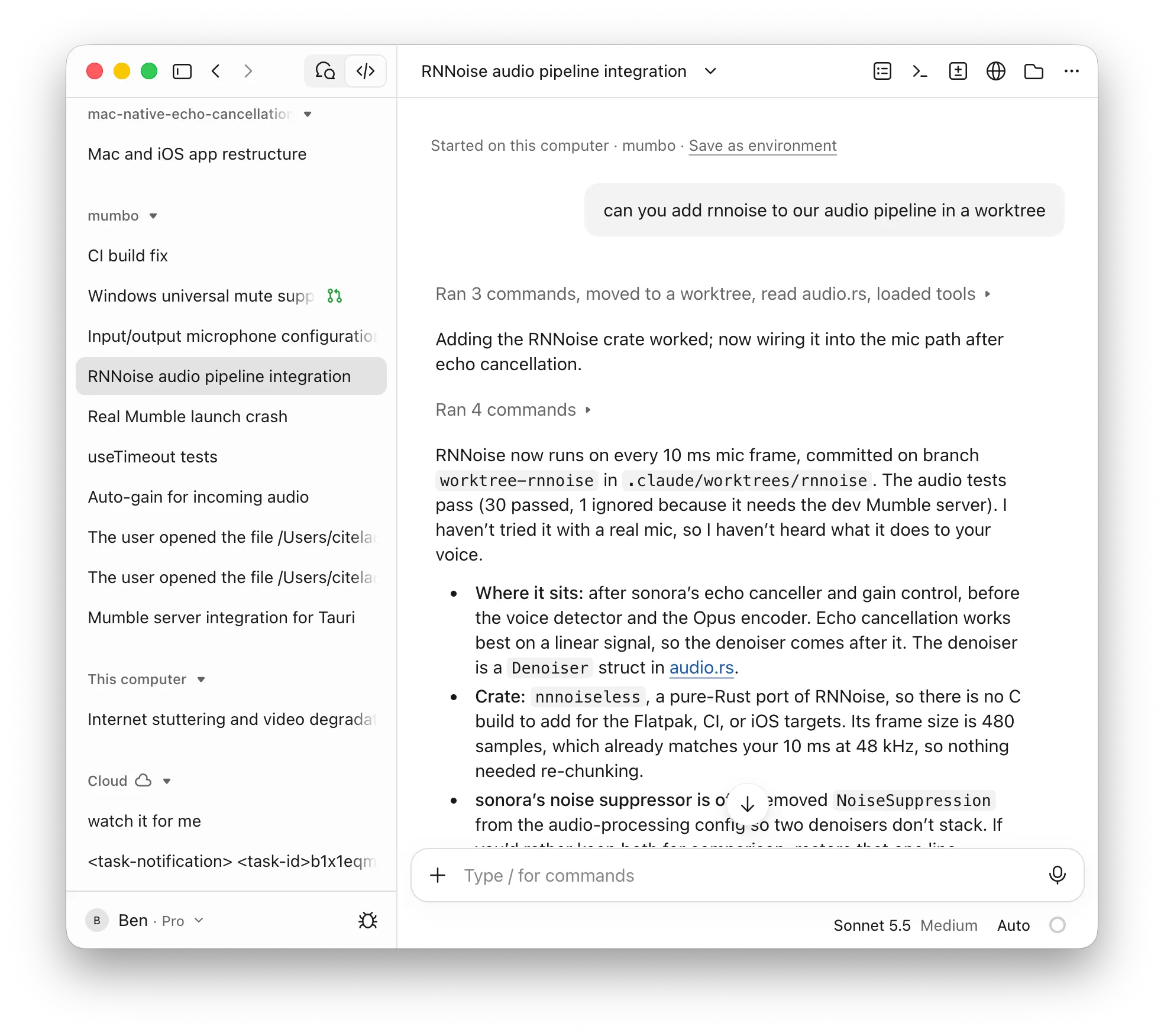
Claude Code adds noise-reduction to (a worktree of) my Mumble client with one prompt
They are nothing short of magic:
-
They let me build fast: agents will prototype any new feature in ~20 minutes. I truly cannot count the number of features, bugfixes, tests, and tools I’ve (AI’ve?) been able to build because of these agents. For example, AI let me test confusing audio code on macOS and iOS in just a few minutes.
-
They let me try crazy things: human teams aim to “fail fast”; agents can fail ultra-fast. I’m happy to test crazy new ideas and throw out what doesn’t work well. It was able to wire & test a huge change to Mumble that added better noise cancelling; I use my beta build of it nearly every day.
-
They remove drudgery: I’ve had agents diagnose & fix urgent bugs with nothing more than a description and a “please fix!” while I continued working on other things.
-
They let me be kinder: since agents write everything, it is simple to propose sweeping changes to my teammates during code review, or even write my own versions — both things unthinkable in the era of hand-written code.
I do not believe engineering is solved: left to run on their own, agents will build poorly-functioning, over-architected, unreadable, self-congratulatory piles of slop. Every friend I’ve asked agrees that agents still need human taste and experience to produce good work. Some of that is minutiae (like that annoying status dot Claude likes to throw onto sites), but most of it is critical. Agents tend to get lost on their own. My most successful work this year was hand-writing a tool, replacing ~4,000 lines of vibe-code with a few hundred. My system has proven more flexible, easier to test, and more generalizable than what it replaced.
It remains to be seen how long that human edge will last, though.
I also now reckon with the fatigue of using these agents. Managing 6 different conversations with 6 different robots about 6 different features is overstimulating & exhausting in a way that coding never was. When I started using agents, I remember rushing to answer their questions like they were human colleagues waiting for help! While I have tempered that anthropomorphic bias, it’s exhausting to juggle so many problems at once. The allure of sending just one more prompt before lunch… then dinner… oy. There is also, as I wrote in Consider the chairmaker, the decline of craft. My friend Peter laments ceding the joy of programming to machines: for many of us, honing the code, finding the right design, seeing the parts mesh together — that was the meditative purpose we found in our jobs. Now, we rarely write anything. We instead delegate it to agent number 7.
But let me return to the joy of working with agents: they are so fast, so open to feedback, and so intelligent. Working with them can be utterly delightful.
For example, while I was building a harness for voice agents, one programming agent decided (correctly) that my simple test harness was insufficient. So it used my Mac’s built-in text-to-speech to directly test the voice agent it was building. Then, newer agents started doing it, too. Either they had documented the technique, or they were each smart enough to independently discover it. Directly testing the product they were building. Absolutely brilliant.
Agents frequently recommend knobs & settings that I’ll reject for being too complex and unnecessary — and, voilà, I’ll need the knob next week. Silly human!
Anyway, because of agentic coding, agentic pull requests are increasingly the way I review agent code. “Make a draft PR,” I write, “I’ll review it soon!” And review it I do — agents still aren’t reliable enough to trust without validating, so I’ll still review their code & test it manually. However, I don’t do the “line-by-line” code reviews I used to do with humans. I focus instead on architecture, on larger patterns in the code. Are there systemic issues with an approach? Should I add new agent guidance to CLAUDE.md? Can I build better test harnesses, so the machines can test their own code?
Agentic code review is surprisingly helpful here: I try to write rules for the code review robots whenever I notice a recurring issue with generated code, so the agents will identify & fix issues by themselves. One rule I enjoyed creating: a "Claude-y comment detector." You think my writing is verbose? Try Claude’s.
On more typical engineering teams, human code review seems increasingly difficult. A friend of mine complained that his teammates simply ask “their” Claudes to review code written by other Claudes. An ouroboros of Claudes! Agents catch bugs & stylistic issues very well, but they are abysmal at designing architecture. Agentic code review is certainly not a replacement for humans yet.
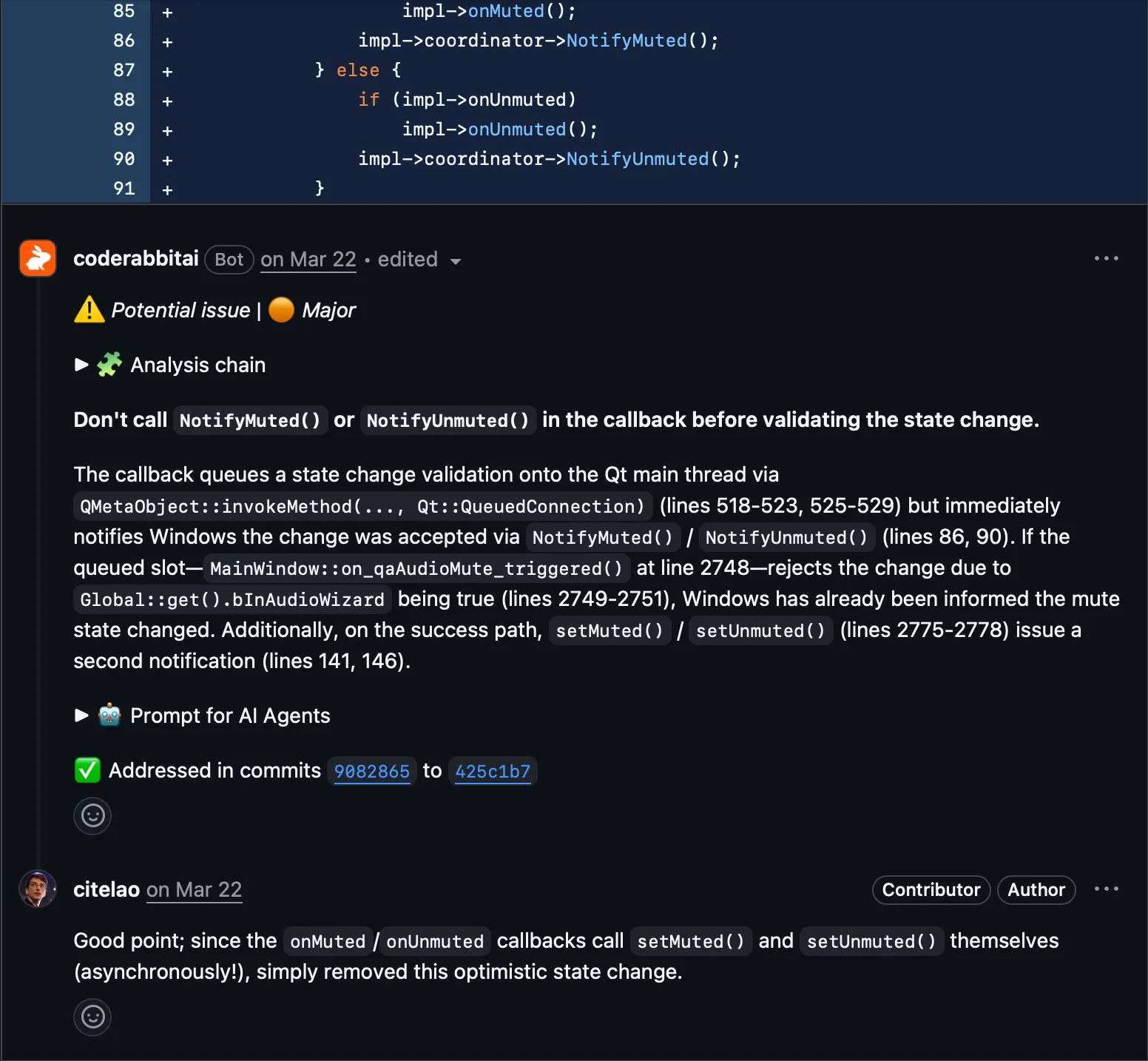
AI code review catches a correctness issue in my code
Last year, I was skeptical of inline editing and code mode, both features of GitHub Copilot. They were not very useful then, and they are even less useful with agents. I have removed them from the table.
| Usefulness | Notes | |
|---|---|---|
| Autocomplete | 👍👍 | Still great, obsolete |
| Agent mode | 👍👍👍 | The most important use of AI today |
| Agentic PRs | 😒 | Validation loop still slow |
| Code review | 👍 | Removes some drudgery, but not human-level yet |
Research & search
Last year, I was excited about research & search: they were the most frequent reason I used ChatGPT. Now, generative AI is the default way I do those things.
The biggest change has been Google’s AI summary. Google’s first or second result is almost always an AI summary, and it’s usually decent. So my traditional search is now AI-first by default. Is it perfect? Absolutely not. In one day, it gave me incorrect URLs for NPR’s RSS feeds and couldn’t find the origin of “AI’ve”.
But none of the top results clearly gave me NPR’s RSS feeds either, and even Claude couldn’t find “AI’ve”. Meanwhile, searching “HP Reverb G2” gave me the specs I was looking for, “ai intelligence is spiky” pointed me to the correct term (“jagged”), “emoji sigh” gave me the right emoji without sending me to a scummy site, and “rel nofollow markdown” reminded me how to link that site without giving them search engine juice.


Product search is still mediocre. I’ll look at the summary when I search “best hysa”, but I don’t trust Gemini to have good advice on where to put my money. Claude certainly helped me explore budget VR options and understand technical details about grease for KitchenAid mixers, but can I trust its coffee table recommendations? Sleeper sofas? Let’s not even mention how uncomfortable it is to see ads in my ChatGPT chats.
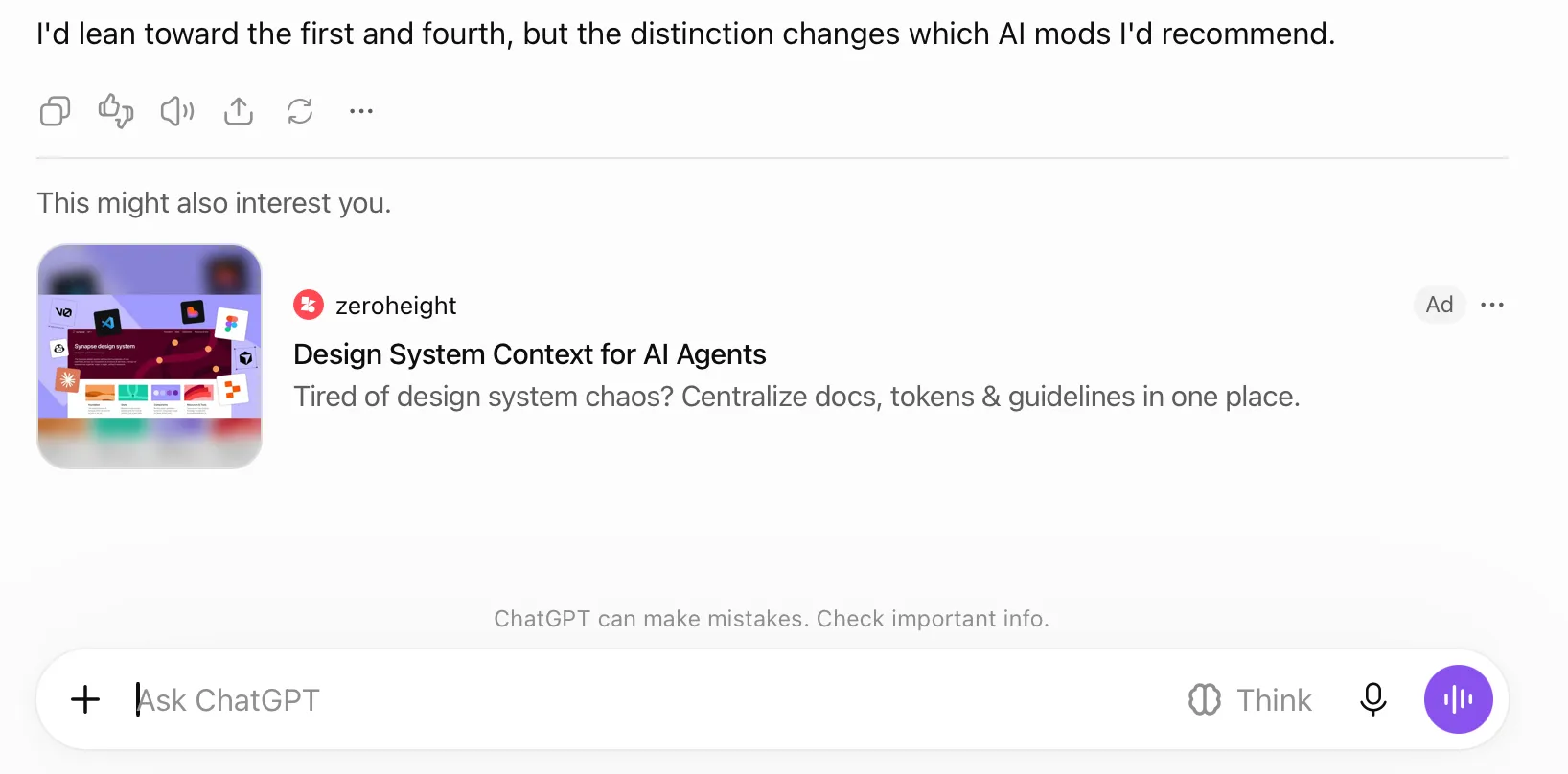
This ad in ChatGPT isn’t even relevant! And it’s still creepy.
Pub facts—stuff I’d ask my wife at a pub — remain awesome with LLMs. Again, Google’s AI summary means “lego cat on a balcony tiktok guy” will help me find @avadonye’s precarious LEGO builds, and “art vtuber who is a lizard on TikTok who gives short tutorials” will help me find Mallow, the art vtuber who is a lizard on TikTok who gives short tutorials.
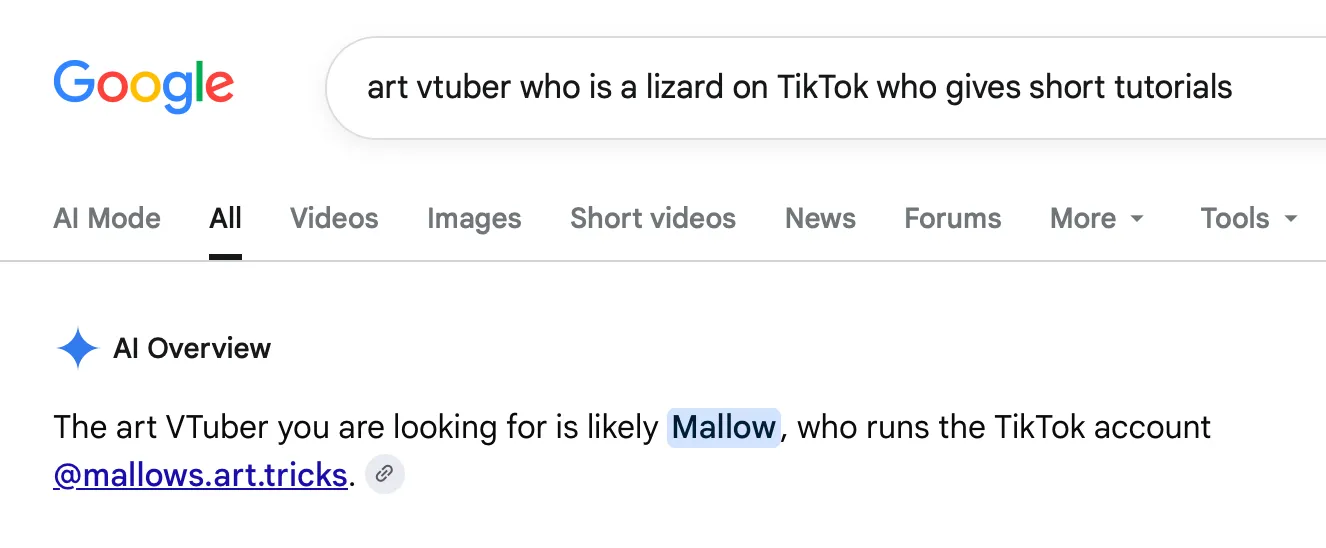
Mallow, the art vtuber who is a lizard on TikTok who gives short tutorials
I often avoid using LLMs for pub facts, in the same way I generally avoided Google for them before, because I like puzzling with my friends. I like Fermi problems.
But I’m more and more excited about using LLMs as teachers to explore well-known concepts. I breezed over this last year, but that is unfair to LLMs. I believe they are the greatest teachers humanity has ever created.
- I had an LLM walk me step-by-step through fine-tuning Mistral to speak like a pirate (yarrr).
- I used Claude to practice responding to an EMS call I heard on the radio.
- I had Claude use a socractic method skill I found via Dan MacKinlay to help me brainstorm new approaches for semantic endpointing (knowing when a user is done speaking) in voice agents.
- I asked Claude to explain typical approaches to a complex legal document.
- I’ve even had Claude quiz me on a long code review, to ensure I understood what the agent had written. The open-source project Mumble actually added a similar quiz to their AGENTS.md a few weeks ago.
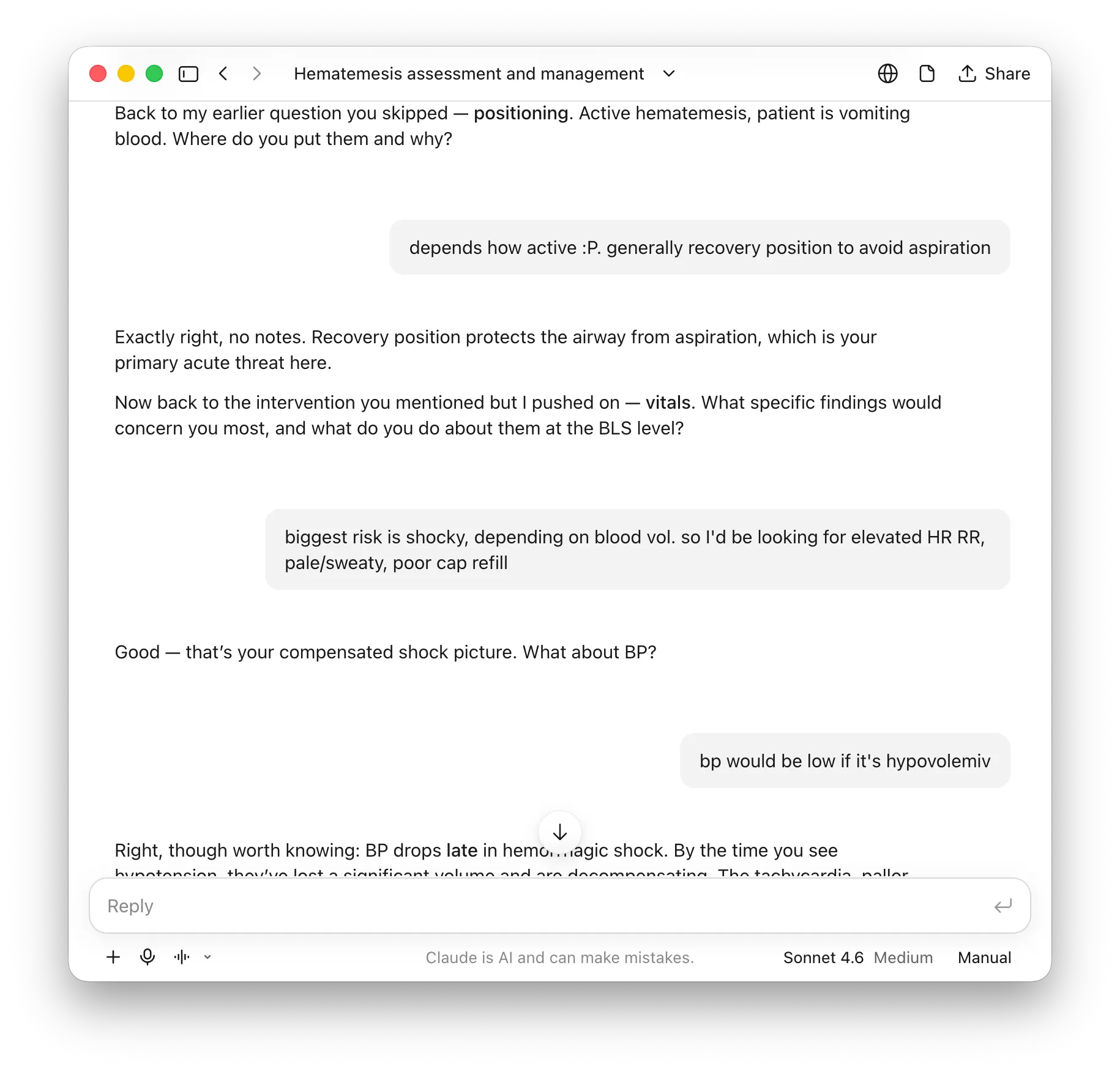
Claude quizzes me on EMT stuff
I am actually jealous of the endless care & patience that these machines show. I hope we discover how to share this patience with our kids while ensuring our kids still learn. Veritasium’s Derek Muller discusses this in What Everyone Gets Wrong About AI and Learning: AI is incredible at drilling repetitive practice, at giving immediate feedback, of all the things a private tutor can do… if you ask it to.
“The world is full of heavy objects,” he says, “and yet most people are not ripped.”
That is my greatest fear with AI tutoring today. That these machines must be reminded to teach. Per Muller, learning requires Type 2 thinking — enaging the slow, reasoning mode of your brain. This is very difficult. Your body will surreptitiously & continuously nudge you out of this mode. Tutors exist to force you back into it. But ChatGPT exists to do things for you: it is so fine-tuned for that use that it tends to forget “it’s meant to be a tutor”, even when previously asked. What learning may occur when you have both forgotten your desire to learn?
This differs from my biggest concern last year: accuracy. Responses then often had basic factual errors, but that seems less of an issue today. I think there are 2 basic factors:
-
I am more AI-literate. I think more of us have a “sense” of what AI can do well, so we avoid the jagged edges.
I don’t, for example, trust ChatGPT’s ability to read sparsely-digitized documents from 1867. So I asked hopefully, then basically ignored its findings.
-
AI is smarter. Just like in coding, I think we hit an inflection point this year, where models are simply smart enough to answer more things reliably.
MAJOR spoilers for Control if you click, but there’s a reason Google’s AI summary of its ending (using Gemini 3, from November 2025) is simple and correct while Bing’s (using ~GPT 4o, from May 2024) is not, conflating the game with its sequel.
This trend extends to literature searches. Last year, I shared my trepidation about using LLMs for complex literature searches. My skepticism remains: these machines have access to everything ever written, so they can support any premise in good faith. Also, it is well-demonstrated that LLMs have default bias, politically or in other fields, like business strategy. I am worried about their ability to subtly impose worldview, either on their own or at the behest of corporations and governments.
Yet LLMs are now my first choice for literature searches. That’s partially because Google searches have that AI summary on top, so I end up reading it, but also because LLMs have been much more effective than traditional search at finding good, nuanced data for me — despite potential bias. You must remember that Google Scholar search kinda sucks: when I started researching Car touchscreens are cheap, not good, for months I could not find any studies beyond one done by an auto magazine—Vi Bilägare. That was despite having worked at a Georgia Tech lab that researched car user interfaces! Especially as they’ve gotten smarter & I’ve developed intuition, LLMs are good finders. Just see Claude’s investigation into human perceptions of latency for me:
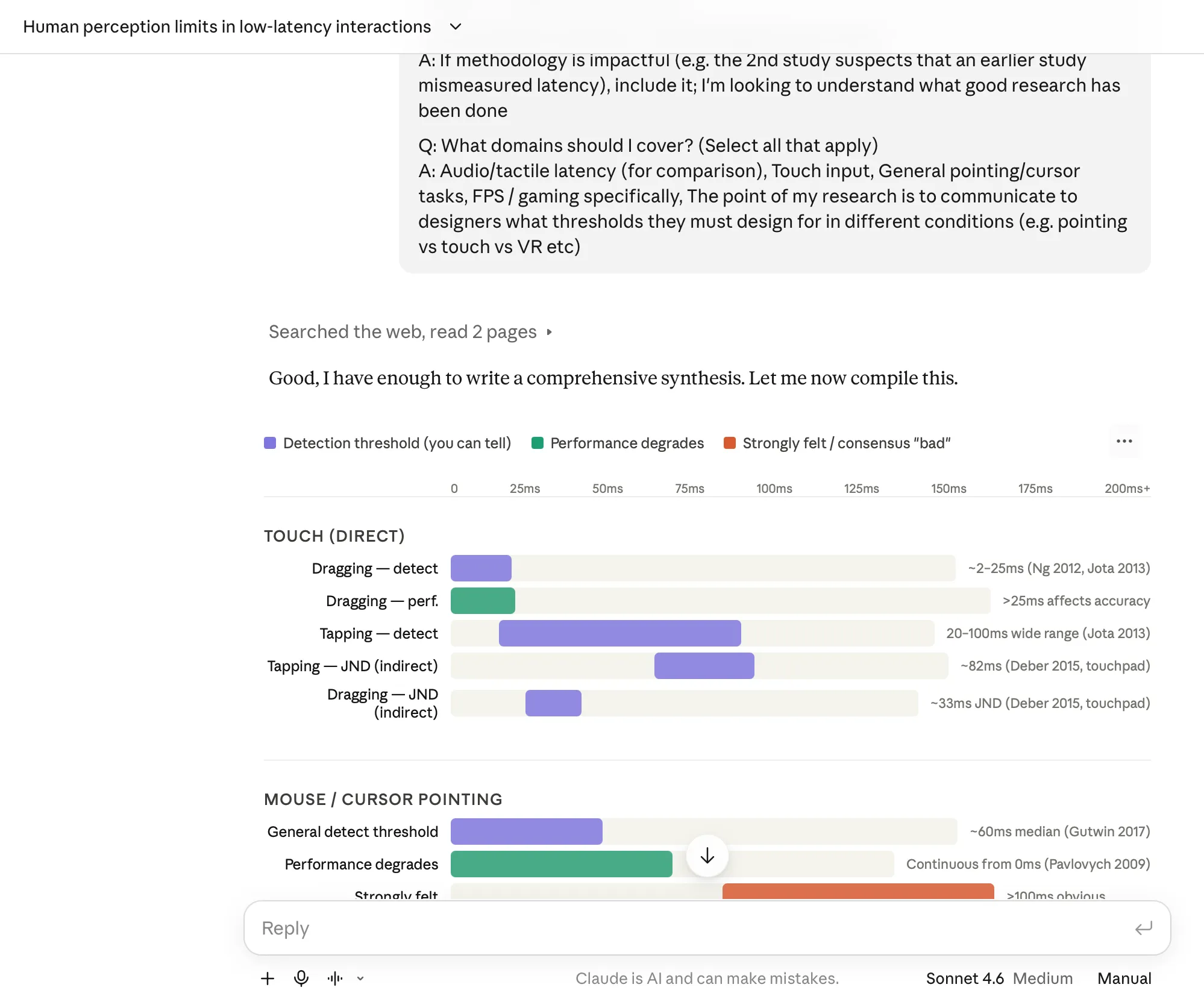
Claude even made graphs!
Ultimately, though, human experts are still more reliable than agents. That’s how I moved forward with “Car touchscreens”—I asked someone from that GT lab. I’ve also been buying more books, even slightly-obsolete ones like Card, Morgan, & Newell’s The Psychology of Human-Computer Interaction (everyone, including LLMs, cite it) or old editions of Wicken’s Engineering Psychology and Human Performance (via a nuclear consultant I met at a wedding). They ground my research, simply by offering a legible worldview.
And that’s why I’ve been disappointed in AI as collaborator for novel research. AI has harmed some research I’ve been doing.
My team at Salesforce has been working on voice stuff, and I’ve been trying to improve turn detection — understanding when a user is done speaking. That’s a hard problem, and it’s been a great opportunity to read fundamental research on how human conversation works (finally!). AI was great at finding that research and good datasets (though my teammates gave me context the AI never did). And it was great when I asked it to use the Socratic method to help me design my own turn detection model — until, on a whim, I asked: “are there better architectures?” Why yes, yes there were. AI had led me astray.
That’s not the only time AI waylaid me. LLMs could not figure out how to annotate that model’s training data correctly. I spent days going back and forth with them, trying to decide how to separate turns from interruptions. It is embarrassing how simple the problem became after one good discussion with a human teammate. LLMs are not yet good companions when brainstorming complicated things.
It is weird to write this when OpenAI just solved a Millenium Problem, proved a weaker version of another, solved hundreds more, and releases more solutions every day. But those results cost “millions of dollars”: you need to burn tokens, having agents review agents review agents… just to produce something coherent. In my case, I find I enter this “AI fog” where it takes more effort to review the agent’s response than to come up with my own answers.
It is obvious that AI researchers are coming. Just… not today, not with me.
| Usefulness | Notes | |
|---|---|---|
| Traditional search | 👍 | It’s now my default, and it’s fine |
| Product search | ❌ | Still tasteless & untrustworthy |
| Pub facts | 👍👍 | Still makes me more annoying at parties! |
| Learning (Explaining well-known concepts) | 🤔👍 | Am I just convincing myself I’m learning? |
| Literature searches | 👍 | Still can support any claim, but at least it’s not Google Scholar |
| (new) Novel research | 🤔 | Coming soon, but not yet |
Summarization & transcription & voice
LLMs (and local models!) remain uninterestingly good at summarization & transcription.
I’ve been using OpenWhispr and Handy to dictate to my computer, especially to talk to my agents. The best models on the planet run on your computer locally, for free. My biggest complaint is that the apps have bugs (hotkeys work inconsistently, etc.). It’s hard to describe a more boring type of success.
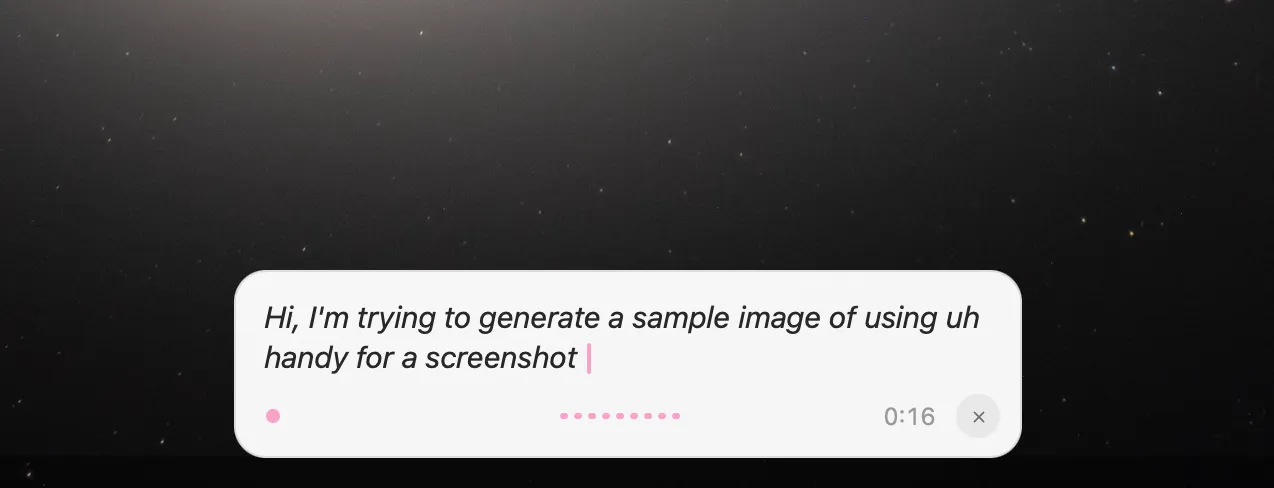
Dictating to my computer, entirely local, entirely free
My meetings have automatic notes. My friend built a local pipeline to transcribe & search his childhood home videos. Vikram Oberoi built a site (in 2024!) that automatically transcribes NYC city hall meetings. You can do all of these things on your Mac.
However, I have yet to reliably use voice beyond dictation.
There’s a reason my team at Salesforce is researching it: voice is the original modality. It should be a seamless way of talking to these human-like robots. But I have never felt compelled to talk to my robots; it’s never been frictionless or private-feeling or useful enough. Does old-school Siri count?
| Usefulness | Notes | |
|---|---|---|
| Summarization | 👍👍 | Boringly good |
| Transcription | 👍👍 | Great for talking to my coding agents! |
| (new) Voice | 🤔 | Seems useful, don’t know how |
Writing
Last year: “ew.” This year: “ew.”
I still do not use AI to write from scratch, nor as an outlining aid, for things I make.
I’ve narrowed this rule a bit from last year. Last year, I argued that LLMs always lacked context and so were poor communicators. With agentic coding, that’s changed. So I’ve had agents document experiments I designed but had no hand in executing, or write READMEs for code they generated end-to-end.
But even that limited exception irks me. I do not like when I stumble upon AI-generated spew, so why should I subject others to it? To that end, I’ve started prompting my agents to identify themselves whenever they write prose, and I often end up rewriting their documents myself (or at least adding an executive summary). That has helped, but I’m not certain it is enough.
In general, I’m surprised how bad AI remains at writing. AI writing is demanding to read: usually plodding, repetitive, and vapid — but then randomly terse and vague, like it doesn’t understand its own words. Agents will so often cite & quote & summarize every paper ever published, then synthesize it all into a mound of nonsense. That is the AI fog I hit: do I misunderstand all these new papers, or did the LLM just serve up some pseudo-profound bullshit? It is bewildering to me that these models can solve generational math problems on one hand, yet utterly fail to describe turn-taking behavior in humans on the other. That is, I guess, their jagged intelligence. They do not reason like we do. They cannot be fine-tuned to speak like we do. So they solve problems we cannot, and share them in reports we struggle to understand.
In any case, it should not be surprising that I do not use AI for writing or outlining in my communication; neither at work nor on this blog. My employer pays me for my ideas, which only I can voice. And I write on this blog for fun. Writing is an art and a skill I enjoy pursuing.
Why would I delegate my voice to a machine that writes tedious dreck?
It’s still great for finding words. Google AI talked me out of writing “hawking off” (which is not an expression) instead of “ceding” later on. But I’m tempering my regard for it as an editor. Despite my positive & worried assessment last year, when I spoke to several friends who asked agents to edit their job applications, their feedback was universally tepid. Agents were sycophantic, reluctant to be critical. And anyone who worked around this (by saying, for example, "my friend wrote this") found that agents offered misplaced, trite advice that lacked nuance. The agents seemed to regress to the mean: helping those with the worst writing and hindering those with the best. The agents were… fine.
As one friend put it:
[AI writing] is as good as it was 3 years ago. Which, when you consider how much everything else has changed since then…
I avoided using AI editors altogether this year, out of fear that they would erase my voice. But I’m increasingly certain they would just blandify it. AI tells remain the same as always (“You’re absolutely right!”), and these machines seem incapable of improvement without substantial guidance. Perhaps it’s survivorship bias, but these very smart machines produce very mediocre writing.
| Usefulness | Notes | |
|---|---|---|
| Writing from scratch | ❌ | Still ew |
| Finding good words | 👍👍 | Still good |
| Editing | 👍 | Mediocre. I don’t use it. |
Art & music & video
Finally, art. I still don’t have a good use for image generation.
Last year, I used AI to generate a few odds and ends, but I stopped this year, mostly out of a vague sense of discomfort. I felt like I was ceding opportunities for creativity to the mediocrity machine.
I’ve enjoyed a lot of the low-effort memes I’ve seen; We need more data centers is one of my favorite jokes all year. And AI helped design some useful presentations I attended. But I’m not sure how AI art fits into life on Earth. Last year I thought I saw AI art at a gift shop. Well, now I’ve seen AI Sketchers ads, AI event posters, AI restaurant menus, AI logos for stores and e-sports teams, AI canvases at HomeSense, and AI t-shirts at Walmart. It’s everywhere, and it’s explicitly replacing human art. Gross.

AI slop shirts at Walmart in Montreal
AI music generation is perplexing in the opposite way. Last year, I worried that I would grow equally tired of it. But no! I’m really enjoying some AI music — and so is the rest of the world. The viral San Juan song inspired covers from humans and lip sync videos from “Mila Kunis, Charlie Puth and Jennifer Love Hewitt”. AI has also inspired new genres: I’ve been humming AI is normal technology? (95k views), LGTM (Looks Good to Me) (1.6M), and The Simulation’s Ending (169k) for weeks. As one commenter wrote on OMG! We’ve found other agents (120k):
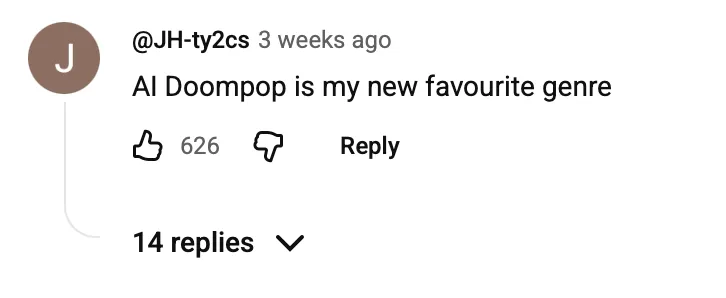
@JH-ty2cs: “AI Doompop is my new favourite genre”
I think AI art & music are beautiful when they are used as lenses for human creativity, rather than replacements for it. I guessed something similar last year, and I think last year’s music proved me right. As soon as commercialism replaced creativity, I was out. I soured on Eiden XII when they started sharing new “but it hits different” covers weekly, and I got bored of steel coils-style edutainment after hearing the first clone. There’s something cynical and manipulative about a synthetic woman belting “talk me out of dying” when some dude (presumably) makes money every time I play it.
Similarly, I haven’t listened to any of the new Doompop that’s hit my feed. It’s cool when you generate a few songs; less cool when you post every day. It feels like vultures picking ad revenue from the corpse of a good idea.
That is evident in the world of video generation. I largely escaped last year (although my mom got some weird whale-cleaning videos), but now I’m seeing a bunch. I see AI ads all the time — most memorably with horrid horse-people in Sixt ads. I got baited into a video of a fake Edna Mode lookalike & some slop WW2 history videos, and my wife got tricked by AI summaries of Adventure Time marketed as sleep aids. All of them hoping to get views, to get ad revenue, to get — as Corridor Digital puts it—“a little bit skimmed off of that YouTube trough.” It is sobering to open an AI history video in Incognito and gaze at the misleading slop recommended next to it:
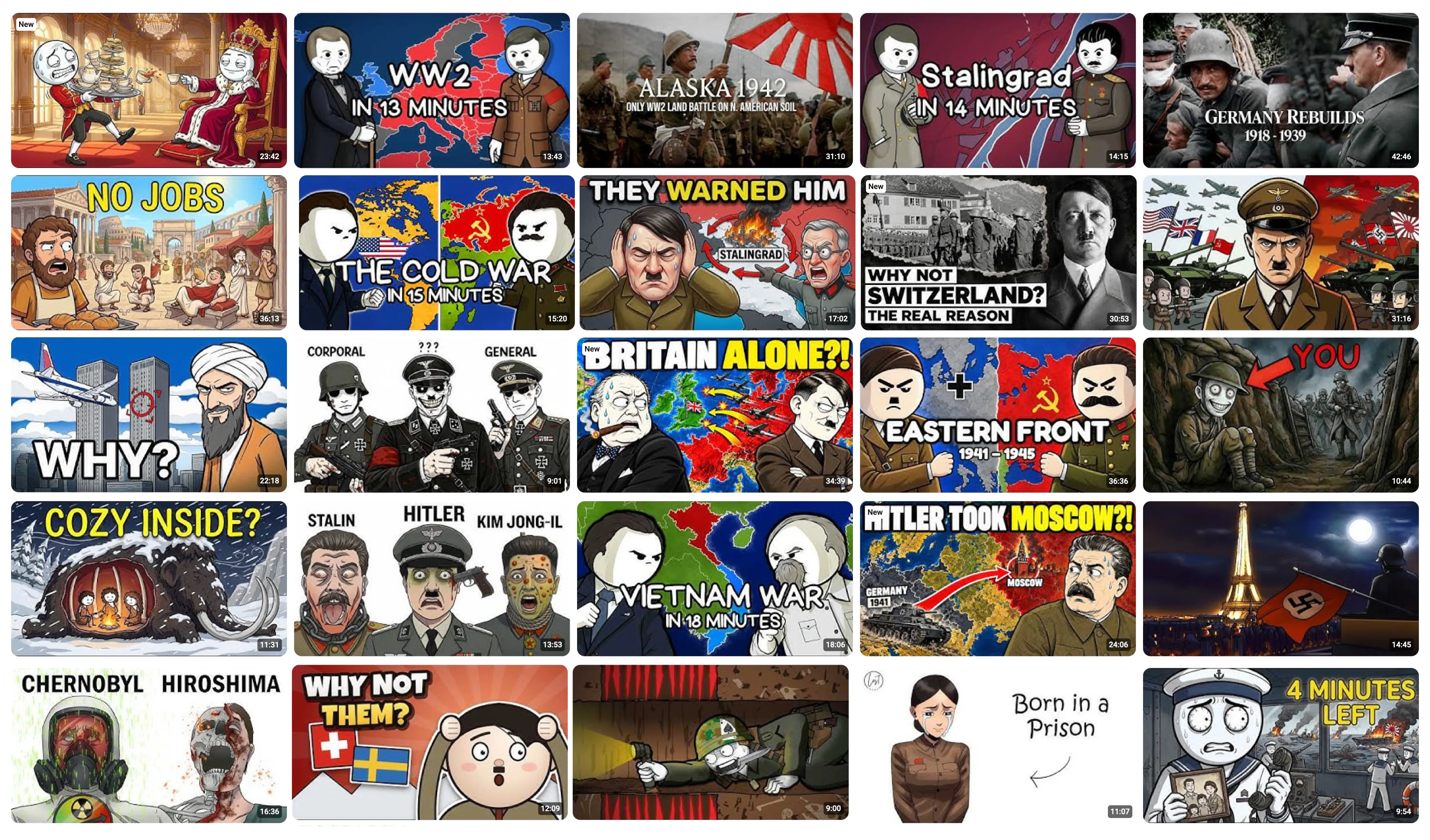
25 of 33 (75%) of the recommendations on an AI slop history video are AI slop
It is horrid to see these machines that can mass-produce art being used to mass-produce art. And I know that seems silly, but there’s a world where we use these tools to elevate artists, just like coding agents elevate me.
I am lucky I do not make my living from art. Art remains valuable to me. Even if AI can write a song faster than I can, I still doodle, I still play piano.
Drawin' it yourself is more fun, anyway.
| Usefulness | Notes | |
|---|---|---|
| Image generation | ❌ | A net negative so far |
| Music generation | 👍 | I like it when it’s non-commercial |
| Video generation | ❌ | Has it ever been used for good? |
Conclusion
So here we are, 12 months later.
12 months since my first abortive attempts to have agents write code. 10 months since Claude Code first made me say, “wow,” when it built me an insurance comparison tool in one shot. And now machines write 90%+ of my code.
It is easy to forget how new this is. 15 months ago, AI did well at a prestigious high school math competition. 2 months ago, AI solved Navier-Stokes.
Last year, I wrote: “I’m confident we’re just starting to see what AI can achieve.” That remains true. We are just now beginning to see what these mechanized coders and mathematicians can build. My friends have built each other tools to communicate. I was able to finally clean up and share a tool I’d started in 2020. Agents helped me finish up an open-source change I’d wanted to make for years, start making an app, test massive changes to old software, and quickly understand new operating systems.
That is just the start.
It is a brave new world. Where these machines also ship corporate slop and leave mathematicians in shock. But I think of how my uncle uses these tools to build his own software; how my friends make software that helps us stay in touch; how these things have helped me learn so, so much. Tools can be used to help people.
That is how I hope to use AI.
Thanks to Peter Kreiseder and Atherai Maran for consulting. Claude helped make the status icon look more Claude-y.
Want next year's article? (and others in between)
No spam. Just an email for new posts.Appendix: my subscriptions
In case you’re wondering, I’m subscribed to:
- Claude Pro ($17/mo)
- GitHub Copilot Pro ($10/mo)
I cancelled OpenAI about a month ago, which is crazy. OpenAI was my first AI subscription! But most of my personal usage is Claude Code, and I ended up using Claude for random questions instead of ChatGPT. And last year we thought OpenAI was so far ahead!
I use GitHub Copilot Pro solely for autocomplete.