My Huel had some cadmium and no detectable lead
I sent my Huel Ready-to-Drink Chocolate shake to be tested for heavy metals after reading an October article from Consumer Reports that found troubling levels of lead & cadmium in similar products. My tests found Huel had a small amount of cadmium (6mcg/kg) and no detectable levels of lead, mercury, & arsenic.
Here are the full details.


Background
On October 14, 2025, Consumer Reports (“CR”) published Protein Powders and Shakes Contain High Levels of Lead (and FAQ & methodology, including full results), which found that Huel Black Edition, alongside other protein powders, contained detectable levels of lead & cadmium and argued that these levels were harmful (emphasis added):
One serving of Huel’s Black Edition powder contained 6.3 micrograms of lead, or about 1,290 percent of CR’s daily lead limit.
[…]
One serving of Huel’s Black Edition plant-based protein powder contained 9.2 micrograms of cadmium, more than double the level that public health authorities and CR’s experts say may be harmful to have daily, which is 4.1 micrograms.
These results have been discussed in great detail by many others, including by NPR, Vox, and Huel on their site and on Reddit. Many Redditors posted blood test results for these heavy metals (I believe all were negative), and Huel also published their NSF Evaluation Report for Huel Black Edition Chocolate. Most of this discussion focused on lead levels, specifically arguing that Consumer Reports’ lead limits were too cautious and that Huel’s lead content was acceptable or even typical.
Personally, I did not find Consumer Reports’ lead levels concerning (for many of these reasons), but I was concerned about the high levels of cadmium they detected. Especially with how these levels differed from Huel’s own NSF report. I resonated with tentkeys’ analysis on Reddit, but simply:
- Huel’s lead level seemed acceptable, both under Huel’s own testing and Consumer Reports’ testing, especially for my limited (one-bottle-a-day) consumption. Their threshold seemed too conservative given other guidelines & typical consumption amounts.
- Huel’s cadmium level, however, exceeded FDA (US Food and Drug Administration) and EFSA (European Food Safety Authority) guidelines for most adults if Consumer Reports’ testing is correct. It was within guidelines if Huel’s NSF testing is correct. (Although both measurements are within JECFA [Joint FAO/WHO Expert Committee on Food Additives] guidelines).
So I cancelled my Huel subscription and decided to mail in some of my Huel for my own testing.
Procedure
On December 9, I ordered a Heavy Metals Beverage Test - 4A from SimpleLab. Soon after it arrived, I filled the container with ~60mL of Huel Ready-To-Drink Chocolate v1.0 (notably, this is not Huel Black, which is the powder CR tested), per instructions, and mailed it out. Sampling was done with clean hands on a clean table.
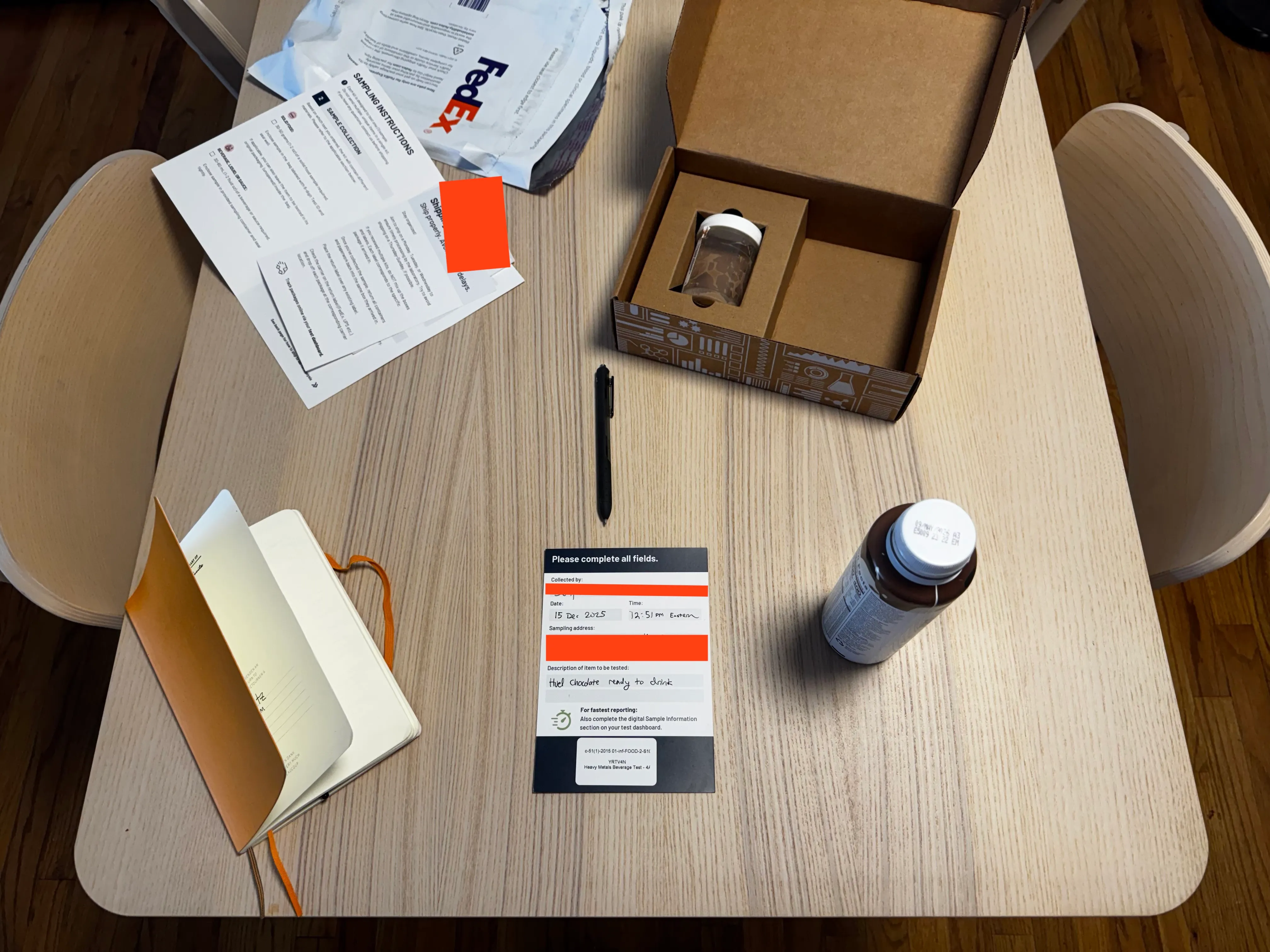
I expected results around January 5, 2026, so I planned to preregister (pre-commit to publishing my results) on Reddit a few days before, then publish results when I received them; however, results arrived on December 23 (the day I write these words), so I pre-committed on GitHub and to a few friends before opening the results.

Results
The results are as follows:
| Analyte | Unit | Result | MDL* | RL** | Method |
|---|---|---|---|---|---|
| Arsenic | mcg/kg | Not detected | 5 | 5 | AOAC 2015.01 |
| Cadmium | mcg/kg | 6 | 5 | 5 | AOAC 2015.01 |
| Lead | mcg/kg | Not detected | 5 | 5 | AOAC 2015.01 |
| Mercury | mcg/kg | Not detected | 5 | 5 | AOAC 2015.01 |
You can read the full PDF yourself.
To convert these numbers into mcg/L, I measured Huel’s density: 60.0mL of Huel weighs 0.063kg, so Huel’s density is 1.05kg/L. This is very close to water’s density of 1.00kg/L, and SimpleLab reports its measurements interchangeably in mcg/kg and mcg/L. I’ve reached out to SimpleLab for clarification, but for this report I’ve used the slightly higher estimate of 1.05kg/L (this increases estimated heavy metal levels). If you prefer to use water’s density, divide my “Normalized per 2000 calories” results by 1.05. SimpleLab confirmed in early January that the measurements are indeed in mcg/kg, so my approach is correct; the numbers work out very similarly in any case. They also included some of their own interpretation, which I’ve included at the end off this article.
Discussion: cadmium
(with daily max levels for a 70kg adult)
My bottle had 6mcg of cadmium per kg. For reference, this was from a 500mL bottle of Huel Ready-to-Drink Chocolate, so a full bottle would contain approximately 3.2mcg of cadmium (6mcg/kg × 1.05kg/L = 6.3mcg/L ⇒ 3.2mcg/500mL).
Normalized to 2000 calories like tentkeys did on Reddit (the analysis linked above), an 100% Huel diet would provide approximately 15.8mcg of cadmium (500mL is 400 calories, so 2.5L is 2000 calories; 2.5L × 6.3mcg/L ⇒ 15.8mcg). This is between Huel’s 7.5mcg measurement and Consumer Report’s 46.05mcg measurement. Summarized here:
| Analysis | Base measurement | Normalized per 2000 calories | Notes |
|---|---|---|---|
| Consumer Reports | 9.21mcg/90g serving | 46.05mcg | Certain flavors have slightly higher calories/g, so this number may be a slight overestimation |
| Huel NSF | 1.5mcg/day | 7.5mcg | Base measurement assumes one 90g serving/day |
| Mine | 6mcg/kg | 15.8mcg |
Adapting tentkeys’ analysis, for a 70kg (154lb) adult consuming 2000 calories of Huel daily (see Fig. 1):
| Guideline | Daily max (mcg/kg body weight) | Daily max (70kg adult) | CR pass | Huel NSF pass | My pass |
|---|---|---|---|---|---|
| JECFA tolerable intake (from PTMI, Provisional Tolerable Monthly Intake) | 0.806mcg/kg | 56.4mcg | ✅ | ✅ | ✅ |
| EFSA tolerable intake (from TWI, Tolerable Weekly Intake) | 0.357mcg/kg | 25.0mcg | ❌ | ✅ | ✅ |
| FDA IRL (Interim Reference Level) | 0.21mcg/kg* | 14.7mcg | ❌ | ✅ | ⚠️ |
As noted in the table, for a 70kg adult, all samples meet JECFA guidelines for cadmium. Both my sample & Huel’s sample, but not the Consumer Reports (CR) sample, meet EFSA guidelines. The FDA IRL is a range of estimated safe values, from 0.21-0.36mcg/kg/day (likely because it is, indeed, an interim value, not a final one). The top of this range basically matches EFSA guidance, and both my sample & Huel’s pass. However, my sample & CR’s sample do not meet the lower bound of the FDA IRL.
I do not know enough to interpret further, but I feel more confident that my daily bottle of Huel has a safe amount of cadmium for me.
Discussion: lead
(with daily max levels for a 70kg adult woman)
The sample had non-detectable levels of lead.
Since the MDL (Method Detection Limit) and RL (Reporting Limit) were both 5 mcg/kg, my results show a maximum of 13.1mcg lead per 2000 calories, using 1.05kg/L and the calorie calculations above.
All the lead results together:
| Analysis | Base measurement | Normalized per 2000 calories | Notes |
|---|---|---|---|
| Consumer Reports | 6.31mcg/serving | 31.55mcg | As above |
| Huel NSF | <3.6mcg/day | <18mcg | As above |
| Mine | <5mcg/kg | <13.1mcg |
Unfortunately, there does not seem to be consensus on safe doses of lead (the JECFA withdrew previous PTMI guidance in 2011 after realizing that it was high enough to be associated with a 3-point decline in child IQ and other effects in adults). Instead, tentkeys collected related advice, which I’ve adapted here. These guidelines have limitations:
- FDA’s IRLs (again, interim reference levels, not final action levels) are not specified “per kg,” so they are hard to generalize to people of different sizes. Also, levels are only provided for ① children and ② females of child-bearing age.
- EFSA’s BMDLs (Benchmark Dose Lower Confidence Limits) are not guidelines; they are tools for setting guidelines.
They measure the dose that increases risk by X% with 95% certainty. For example, the BMDL01 is the dose that increases risk by 1% with 95% certainty.They are the lower bound of the 95% confidence interval of the dose that increases risk by X%. For example, the BMDL01 is the dose which, with at least 95% confidence, is too low to produce a 1% increase in risk (thanks tentkeys for the correction). While that is useful, I expect that health guidelines are based on more than just BMDLs. - P65 levels (Proposition 65), the basis for CR’s guidelines, include a 1000x safety factor, which is widely regarded as too conservative. Here’s CR quoting a paper that says so.
I’ve also included, but not graphed, the FDA’s action levels for “Lead in Processed Food Intended for Babies and Young Children,” since it is provided in Parts Per Billion (ppb) of food, not in terms of mcg per kg body weight. The EU requires liquid infant formula to meet the same guidelines.
As shown in Fig. 2, above, a 70kg adult woman (since the FDA IRLs are for women and children) consuming 2000 calories of Huel daily would be below EFSA BMDL levels for lead intake for all results, including Consumer Reports’, but above the FDA IRLs and Proposition 65 levels for Consumer Reports’ data. The NSF testing and my testing are not sensitive enough to claim anything about the FDA IRLs or Prop 65 warnings. Not graphed, my testing passes FDA action levels, but CR’s does not; NSF testing is not sensitive enough to make any claim. In table form:
| Guideline | Daily max (mcg/kg body weight) | Daily max (70kg adult) | CR pass | Huel NSF pass | My pass |
|---|---|---|---|---|---|
| JECFA tolerable intake | - | - | - | - | - |
| EFSA tolerable intake | - | - | - | - | - |
| EFSA intake derived from the BMDL10 for kidney effects in adults | 0.63mcg/kg | 44.1mcg | ✅ | ✅ | ✅ |
| EFSA intake derived from the BMDL01 for neurodevelopmental effects in children | 0.5mcg/kg | 35mcg | ✅ | ✅ | ✅ |
| FDA IRL for children (2.2mcg/day) | * | * | ❌ | ⚠️ | ⚠️ |
| FDA IRL for females of child-bearing age (8.8mcg/day) | * | * | ❌ | ⚠️ | ⚠️ |
| Prop 65 maximum allowable dose (0.5mcg/day) | * | * | ❌ | ⚠️ | ⚠️ |
| FDA action levels for processed foods intended for babies (10-20ppb; not graphed) | † | † | ❌ | † | ✅ |
My tests and the NSF testing were not sensitive enough to determine if an all-Huel diet is below the FDA daily lead IRLs, much less the Prop 65 limit. Given that Americans typically consume 1.7 to 5.3 mcg/day & Europeans consume a lot more, I am comfortable drinking my daily bottle of Huel (<2.6 mcg according to my data). But Huel’s lead content has been discussed at length, and I doubt I have any insights to add here beyond the results themselves.
Discussion: arsenic and mercury
Finally, the sample had non-detectable amounts of arsenic and mercury.
Aggregated results for arsenic:
| Analysis | Base measurement | Normalized per 2000 calories | Notes |
|---|---|---|---|
| Consumer Reports | 1.42mcg/90g serving | 7.10mcg | As above |
| Huel NSF | <3.6mcg/day | <18mcg | As above |
| Mine | <5mcg/kg | <13.1mcg |
And mercury:
| Analysis | Base measurement | Normalized per 2000 calories | Notes |
|---|---|---|---|
| Consumer Reports | 0.08mcg/serving | 0.40mcg | As above |
| Huel NSF | <0.72mcg/day | <3.6mcg | As above |
| Mine | <5mcg/kg | <13.1mcg |
Since all sampled results (including the Consumer Reports results!) are below the NSF detectable threshold, I suspect these levels are OK. I don’t know enough to comment further.
Conclusion
I hope this additional data proves useful to you. It has made me confident enough to resume my daily Huel breakfast, and I plan to resume my Huel subscription.
I truly hope I have presented this data fairly & added clarity to the discussion.
Thanks to SimpleLab for running these tests, for their quick responses, and for sharing their own analysis. Thanks to tentkeys on Reddit for their fantastic meta-analysis of guidelines & data. Thanks to Atherai Maran for editing. Thanks to tentkeys for some corrections. Any errors are my own.